

Infostealer malware took at least one staff email login at 41% of 4,824 organizations in the U.S. and Europe over the past year, according to Outpost24's 2026 Credential Exposure Benchmark Report. The report covers five industries, healthcare and medical among them. Infostealers supplied under 3% of the 31.5 million exposed credentials it analyzed, with breach dumps and combolists making up the rest, but the infostealer logins are the ones to worry about. They're "far more likely to reflect recent theft," which means they're more likely to still work.
Those logins are usually stolen somewhere your security team can't see. According to the Ransomnews Infostealer Exposure Dataset, a stealer-log record typically comes from a personal or unmanaged computer where an employee saved work passwords in the browser. Your firewall, endpoint tools, and email filters never witness that theft. The first time they see the password is when someone else uses it.
Employee logins turned up in stealer logs at 46 of 48 hospitals
For a healthcare-only view, the November 2026 Ransomnews snapshot found employee credentials in stealer logs at 95.8% of the 48 hospitals and health systems it tracks. It's a small panel drawn from one licensed stealer-log index, but it matches Outpost24's broader data: nearly every hospital measured had at least one staff login in criminal hands.
The exposure is also fresh. The snapshot logged 360 new healthcare employee credentials in the 30 days before it was taken. A cleanup from last quarter won't catch those.
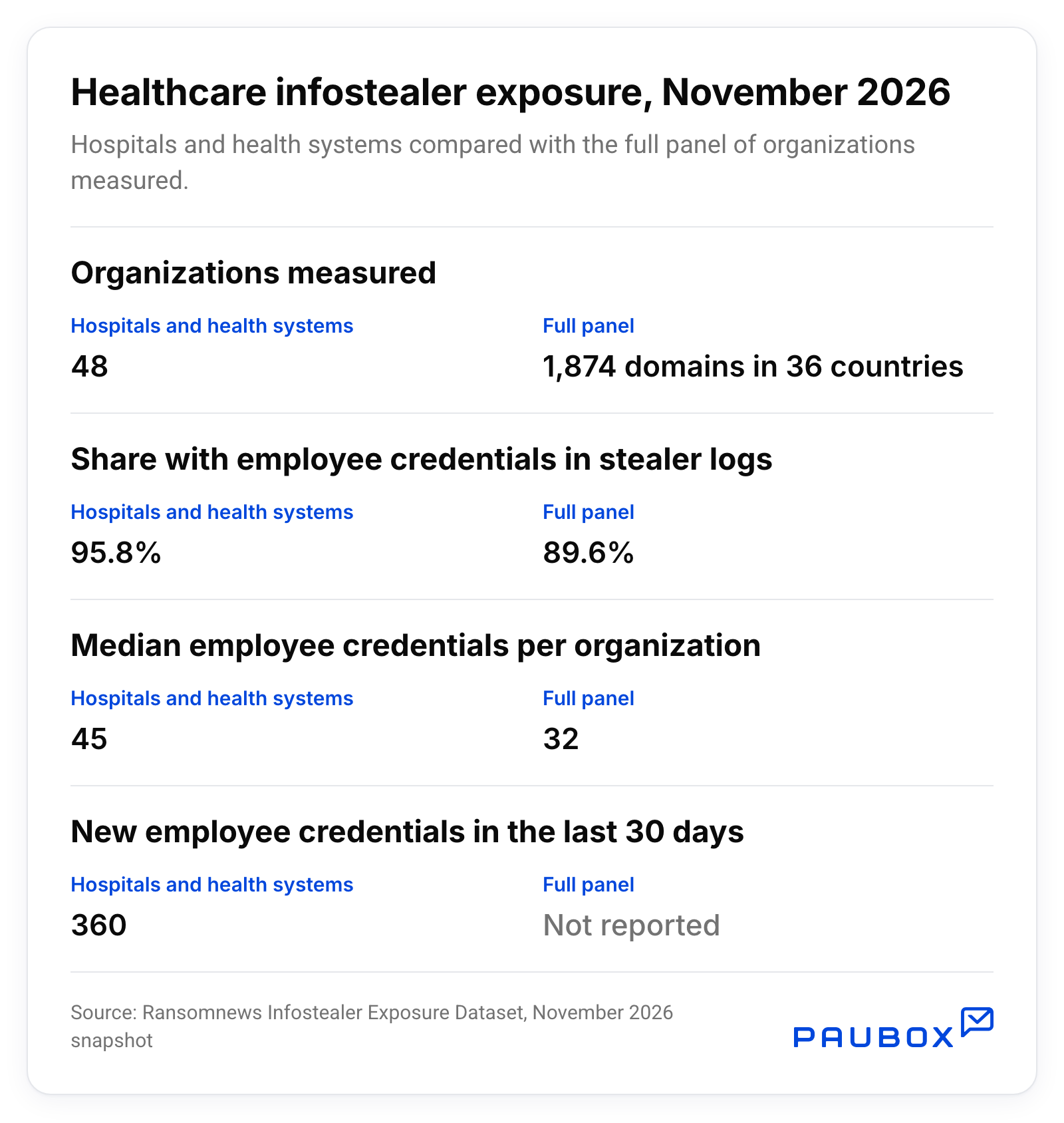
Source: Ransomnews Infostealer Exposure Dataset, November 2026 snapshot.
The theft happens outside your device inventory
Ransomnews describes a stealer-log record as produced "on an infected device, usually a personal or unmanaged machine where an employee saved work passwords in the browser." That record means the credential is in criminal hands. It doesn't, by itself, mean the organization's own systems were breached. Outpost24 also treats a staff credential in an infostealer log as a sign of malware on a device used for work, whether company hardware or a personal device.
Federal health-sector analysts have documented how this malware works. An HHS Health Sector Cybersecurity Coordination Center (HC3) analyst note on Vidar, a long-running infostealer, says it collects "account credentials," "credit card data," and "browser history" from infected computers, and spreads through phishing attachments and fake installers for legitimate software.
Picture a nurse manager who checks work email on a home laptop the whole family uses. Someone installs a pirated game, the installer carries a stealer, and every password saved on that laptop goes with it, including the work login.
A stolen login leads straight to the mailbox
Paubox's breach analysis shows where that access ends up. In The top 3 healthcare email attacks in 2025, Paubox reviewed 170 email breaches reported to HHS and linked about 17% of them to mailbox takeovers, which exposed more than 630,000 people. By patient impact, that made mailbox takeover the most damaging email attack type of the year.
"Phishing is the attack point. Inbox access is the objective," the report says. An infostealer reaches the same objective without a phishing email ever landing in the mailbox it unlocks.
HC3 has flagged the same pattern in groups that target healthcare. In its updated Scattered Spider threat profile, as HIPAA Journal reported, HC3 listed several infostealers the group has used, and HIPAA Journal summarized that "information stealers are commonly used to obtain credentials for initial access."
Go deeper: Why do mailbox takeovers expose more patients than other email attacks?
Stolen session cookies can outlast a password reset
Infostealers take more than passwords. The Ransomnews healthcare snapshot counted more than 2.1 million stolen session cookies for the domains it measured, and a session cookie is what keeps a user signed in without asking for the password again.
That's why Ransomnews tells organizations to revoke active sessions for every exposed account "so stolen cookies stop working." A password reset by itself doesn't end a session that's already open.
It's also why multi-factor authentication (MFA) can't carry this alone. Paubox's breach analysis lists treating MFA as a backstop among the common failures behind mailbox takeovers. The Cybersecurity and Infrastructure Security Agency (CISA) urges organizations to adopt phishing-resistant MFA, which makes a stolen password far harder to use at sign-in, and short session lifetimes limit how long a stolen cookie stays useful.
Assume some logins are already exposed and plan for the one that looks legitimate
For every account that shows up in a stealer log, Ransomnews recommends these steps, and Outpost24 gives similar advice to investigate the user and the device, not just the password:
- Reset the password
- Revoke active sessions
- Re-enroll MFA
- Find the infected device
After that, block browser password saving for work accounts in favor of a managed password manager, and shorten session lifetimes on single sign-on.
Then watch what happens after a valid sign-in, since that's where an attacker using a real login shows up. The Paubox mailbox-takeover analysis points to new inbox rules that forward or hide messages as one sign, and to emails sent from the compromised account to colleagues and partners as the next step. That second step is where inbound email security fits. The session and MFA steps above protect the sign-in itself. When a staff or partner account is compromised and starts sending phishing to your people, Paubox inbound email security, including ExecProtect+, helps catch those messages before they reach inboxes, so one takeover is less likely to become several.
Read also: Actions to take following a mailbox compromise
FAQs
What is an infostealer?
An infostealer is malware that copies saved passwords, browser cookies, and other data from an infected computer and sends it to an attacker. HC3's analyst note on Vidar describes one common family. Go deeper: Infostealers: A rising malware threat in the healthcare industry
Does a credential in a stealer log mean we've had a HIPAA breach?
Not on its own. Ransomnews notes that a stealer-log record shows a credential is in criminal hands, which by itself doesn't mean your systems were breached. If someone uses it to get into a mailbox holding unsecured PHI, that access is presumed to be a breach unless a documented risk assessment shows a low probability of compromise. See actions to take following a mailbox compromise.
Does email encryption protect a mailbox if the password is stolen?
No. Encryption protects messages in transit and at rest, and it's still required for HIPAA compliant email. Someone signed in with a stolen password reads those messages as the user.