
The HHS Office for Civil Rights (OCR) has finalized changes to the HIPAA Privacy Rule that give HIPAA covered entities (health care providers, health plans, and health care clearinghouses) 15 calendar days instead of 30 to act on a patient's records request. The rule also ends the signed acknowledgment of your Notice of Privacy Practices (NPP), takes effect January 18, 2027, and requires compliance by July 17, 2027.
OCR announced the final rule on November 16, 2026, almost six years after it proposed these changes in January 2021. "Americans should never have to fight for access to their own health records," HHS Secretary Robert F. Kennedy, Jr. said in the announcement.
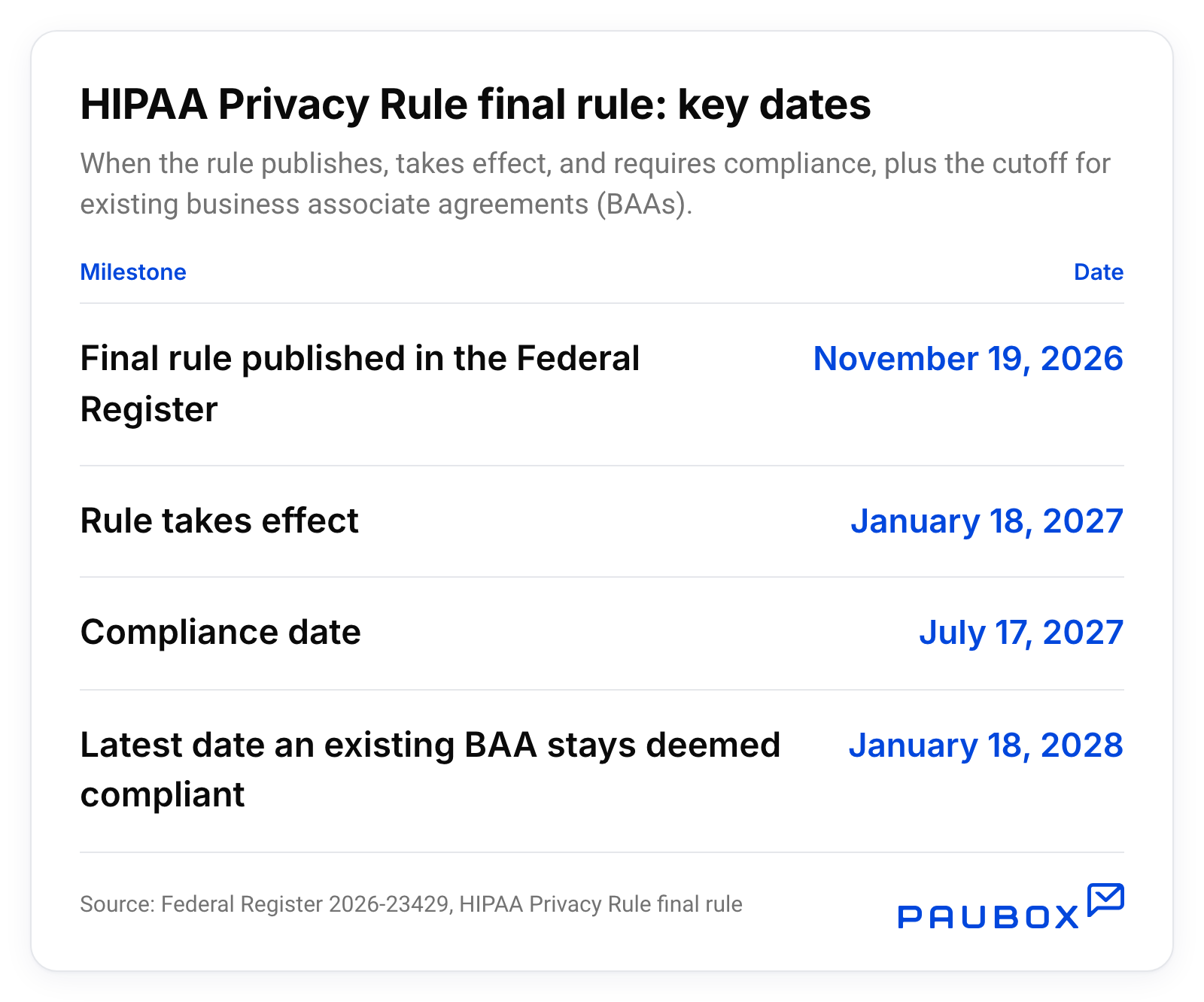
Source: Federal Register 2026-23429
You'll have 15 days to answer a records request
Under the final rule, you must act on a patient's request for their protected health information (PHI) within 15 calendar days of receiving it. You can still take one extension of up to 30 more days.
That cuts your records staff's default window in half. The current HIPAA right of access provisions and their 30-day standard stay in force until the compliance date.
OCR already enforces late responses under the 30-day rule. In August 2026, it settled with Azul Vision for $50,000 after a patient waited almost two years for her records, according to Paubox's coverage of the case.
Free access and posted fee schedules
You can't charge a fee when a patient looks at their records in person or gets their electronic PHI (ePHI) online, such as through a personal health app.
If you charge for copies, you must post a fee schedule on your website, if you have one, and have it ready at the front desk and on request. The schedule has to list every type of access that's free and your standard fees for copies.
Limits on identity checks and request methods
The rule bars "unreasonable" identity verification. That means any check that makes a patient spend unnecessary effort or resources when a simpler option would work for you.
In its commentary, OCR says it would generally be unreasonable to make patients use only one electronic method, such as a portal, when you could also accept requests by email, personal health app, or a health information network.
Patients can direct electronic copies to another person
Patients can still direct you to send their records to someone else. The final rule limits that right to electronic copies of PHI in an electronic health record, in line with a binding federal court decision (Ciox Health, LLC v. Azar).
Encrypted email gets records out fast without extra steps
OCR's commentary states that email "generally is considered readily producible by all covered entities," except when a file, such as a set of images, is too large to send. It also notes that a patient may ask to receive their PHI by unencrypted email after accepting the risks.
With 15 days on the clock, there's less room for back-and-forth over how records go out. Sending them by HIPAA compliant email keeps encryption as the default, so your staff aren't walking each patient through the risks of an unencrypted message. Paubox seamlessly encrypts emails, and patients read them in their own inbox without a portal login or password.
You no longer need a signed NPP acknowledgment
If you treat patients directly, you no longer have to get their written acknowledgment that they received the NPP. The rule also drops the duty to document a good faith effort when you can't get a signature, and the six-year retention requirement for that paperwork.
You still have to give patients the notice. The final rule updates its content so patients can see their rights and how to use them, and it must list the name or title, phone number, and email address of a contact person.
You can share records with social services for care coordination
The rule confirms you can share PHI, without the patient's authorization, with social services agencies, community-based organizations, and similar groups when it supports that patient's care coordination or case management.
Existing business associate agreements get a transition period
A business associate agreement (BAA) signed before November 19, 2026, that meets the current rules counts as compliant until January 18, 2028, or until you renew or change it on or after July 17, 2027, whichever comes first.
If you renew or change a BAA between January 18 and July 17, 2027, it loses the transition period, so bring it up to the new rules when you make that change. By January 18, 2028, every BAA has to meet the new rules. If a business associate holds a patient's PHI, you still answer that patient's access request.
Plan how records go out before the 15-day clock starts
The 15-day deadline changes daily work more than any other part of the rule, and the fastest way to meet it is one standard delivery method for every request. Before July 17, 2027:
- Update your access policy and staff training to the 15-day deadline
- Accept requests through more than one channel, including email
- Send records by encrypted email so they reach the patient's inbox without a portal
- Post a fee schedule if you charge for copies
- Retire the NPP acknowledgment form and update the notice
- Check each BAA against the new rules when it comes up for renewal