


.svg)
.svg)
.svg)
.svg)
.svg)
.svg)
.svg)
.svg)
.svg)
.svg)
.svg)
.svg)
.svg)
.svg)
.svg)
.svg)
.svg)
.svg)
.svg)
.svg)
.svg)
.svg)

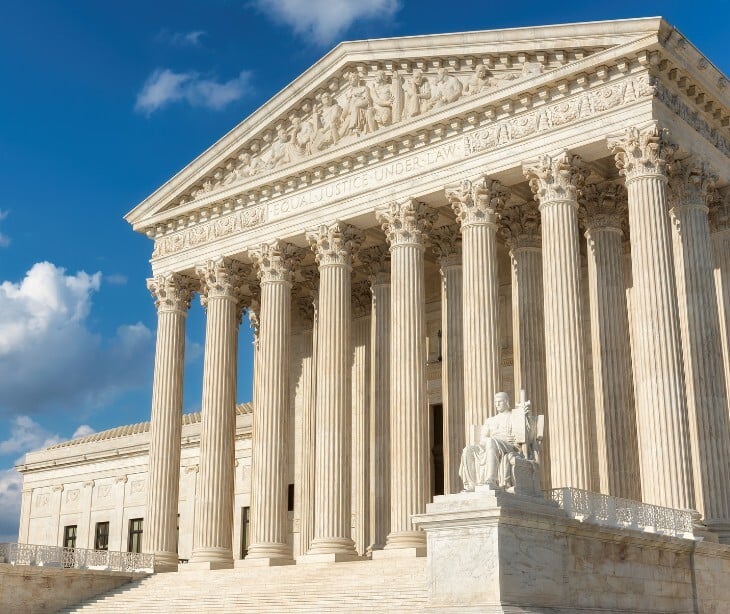
The Supreme Court ruled 6-3 on June 29th that police collection of phone location data from a geographic area counts as a Fourth Amendment search, a decision with implications for digital privacy.
What happened
The Court decided Chatrie v. The United States, a case stemming from Okello Chatrie's bank robbery conviction, which relied on a geofence warrant that pulled location insights from Google about his whereabouts near the crime. The Court avoided ruling on whether that specific warrant was valid, but held that the Fourth Amendment applies to this type of data collection, and potentially to similar future methods. The majority compared cell location data to the cell-site location information at issue in Carpenter v. United States (2018), where the Court likewise found that government collection of that data constitutes a search.
Going deeper
The Court weighed whether bulk, generalized data collection meets the definition of a search under the Fourth Amendment, and whether people who voluntarily share data with companies like Google still retain Fourth Amendment protection over it, a question tied to the "third-party doctrine." Justice Neil Gorsuch wrote separately, agreeing with the outcome but reasoning that location history qualifies as personal property protected under the Constitution's language on "papers" and "effects."
What was said
Justice Kagan wrote for the majority that new technology should not change what people reasonably expected to keep private from the government, and that police intrude on a constitutionally protected interest when they demand cell phone location records from a third-party company, even briefly.
Justice Alito, dissenting, warned the ruling "will send seismic waves through our Fourth Amendment doctrine" and predicted lasting legal fallout.
Law professor Andrew Ferguson called the ruling a major win for Fourth Amendment privacy and credited the Court with updating constitutional protections for the digital age.
The ACLU's Brett Max Kaufman said the decision protects against invasive, overbroad government searches of personal data, and warned that similar reverse searches of sensitive data held by other companies remain a privacy threat.
In the know
A geofence warrant lets police request data from a tech company, like Google, on all devices that were within a certain geographic area during a specific time window, rather than targeting a known suspect.
Why it matters
The ruling closes a loophole that lets police sidestep warrant requirements by asking a tech company for everyone's location data in an area rather than targeting an individual, and that same loophole logic applies directly to healthcare data. Health apps, wearables, and patient portals generate location and usage data that often isn't covered by HIPAA once it passes through third-party vendors, similar to how Chatrie's Google location history sat outside traditional Fourth Amendment protections until this ruling. Because the Court rejected the idea that voluntarily sharing data with a company strips away privacy protection, the decision reinforces that data held by a third party, whether it's location history or health information, can still carry constitutional or regulatory weight. For healthcare organizations already navigating HIPAA, state privacy laws, and scrutiny over tracking technologies, this ruling adds a push for stronger protections over sensitive personal data, including health-adjacent data that falls outside HIPAA's current scope.
The bottom line
The Chatrie decision extends Fourth Amendment protections into the digital age. For healthcare organizations, the ruling is a reminder that data privacy expectations are tightening. As patients and regulators pay closer attention to how location and health-related data move through third-party vendors, covered entities should treat this as another signal to tighten data-sharing practices and stay ahead of compliance gaps.
FAQs
What is the Fourth Amendment?
The Fourth Amendment is a constitutional protection against unreasonable government searches and seizures of a person's body, property, or information.
What is a search warrant?
A search warrant is a court-authorized document that allows law enforcement to search a specific person, place, or set of records, based on probable cause.
What is the Supreme Court's role in interpreting privacy law?
The Supreme Court interprets how constitutional protections like the Fourth Amendment apply to new situations, including evolving technology, and its rulings set binding precedent for lower courts.
What is the third-party doctrine?
The third-party doctrine is a legal principle suggesting that people may have reduced privacy protection over information they voluntarily share with companies or other third parties.
